Getting there, and how long it really takes
Cape Coast is about 145 kilometres west of Accra, which should be a two-hour drive and is usually two and a half to four. The bottlenecks are getting out of Accra, the Kasoa junction and the Winneba stretch. Leave before 6.30am and you beat most of it. Buses and tro-tros leave from Kaneshie, and an air-conditioned bus is roughly GHS 60 to GHS 100 while a tro-tro is GHS 40 to GHS 70.
Elmina is 12 to 15 kilometres further west, 20 to 30 minutes from Cape Coast, with tro-tro and taxi fares around GHS 10 to GHS 30. Kakum is 30 to 40 minutes north of Cape Coast, and Assin Manso is about 45 minutes north on a different road.
Base in Cape Coast for the castles, or in Elmina if you want the town in the evening. Two nights is the minimum. Three lets you add Kakum and the smaller forts. A private car and driver from Accra for the round trip is roughly GHS 900 to GHS 1,400 a day.
- Castle fees are revised, so confirm at the gate. Figures here are planning ranges.
Cape Coast Castle: how to do it properly
Cape Coast Castle began as a Swedish trading post in the 1650s and passed to the British, who held it for most of its history. What you see is a whitewashed fort above the sea with a courtyard, a church, governors' quarters, cannon batteries and the male and female dungeons below. The guided tour is compulsory, lasts 45 to 90 minutes, and ends at the Door of No Return.
The guides are usually excellent and often descendants of people from the surrounding towns. Ask questions, keep your voice down in the dungeons, and let the room do its work. Photography is usually allowed in the courtyard and restricted inside and in the museum, so ask rather than assume.
Entry for a non-Ghanaian adult is commonly GHS 80 to GHS 150, with lower rates for Ghanaians. Go at opening time, around 9am, or in the last two hours of the day. Midday brings heat and coach groups. Give yourself time after the tour. Sitting on the wall above the sea for half an hour is part of the visit.
- Dress respectfully: covered shoulders and knees, no beachwear.
- The museum upstairs fills in dates the tour skips. Read it.
Elmina Castle: the older, stranger one
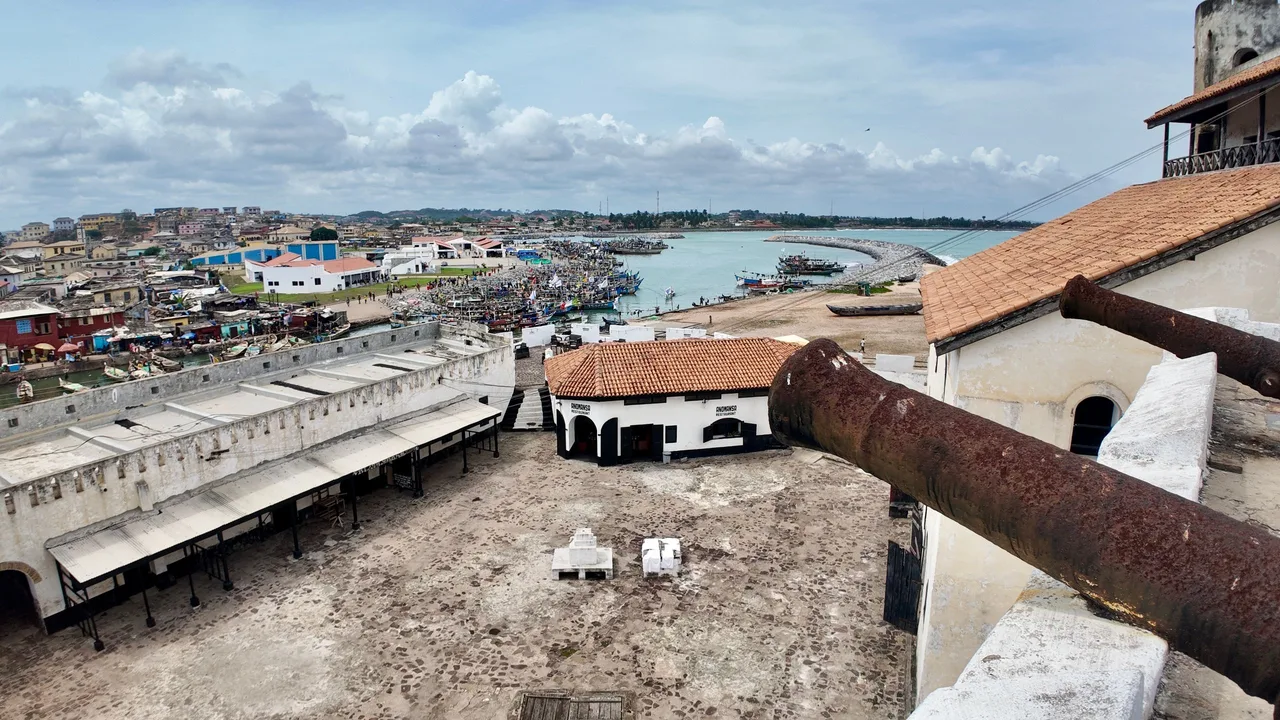
Elmina Castle, built by the Portuguese from 1482 and usually described as the oldest surviving European building in sub-Saharan Africa, is a different experience from Cape Coast. It was a trading fort before it was a slave depot, and it sits inside a working fishing town rather than above it. From the walls you look down on canoes, the Benya Lagoon and the roofs of Elmina.
The interior is stranger and more layered: a Portuguese church later used as an auction hall, the Dutch governor's quarters, cramped dungeons, and a small door in the female dungeon that opens onto the sea. Entry is in the same range as Cape Coast and the tour is guided only. It is shorter than Cape Coast and the site is smaller, but it stays with people longer.
Above the town, Fort St Jago is a short, hot climb with the best view of the castle, the lagoon and the coast. Entry is small and the caretaker will often walk you through. Go late afternoon for the light.
- Elmina Castle is in the middle of town. Parking is tight and the walk in is crowded.
- The climb to Fort St Jago is uneven. Wear shoes with grip.
The towns after the tour
Cape Coast town rewards an hour on foot. Kotokuraba Market is its working heart, and the streets between the market and the castle hold crumbling Fante merchant houses with ornate balconies worth looking up for. Fort William on the hill above is small and quiet. The beach beside the castle is rough and not for swimming.
Elmina is more working port than resort. The lagoon bridge, the fish market and the boat yards are the reasons to wander. The small Java Museum covers the Dutch period and the soldiers brought from Java, and is worth 30 minutes if it is open.
Eat Fante food here: kenkey with grilled tilapia, fried fish, cassava chips and coconut. A chop bar plate is GHS 30 to GHS 80 and a proper tilapia meal at a seafront place is GHS 120 to GHS 300. Ask the price of fish by weight before it goes on the grill, because a large tilapia is not a small purchase.
- Do not swim near the castle. The current and the rocks make it dangerous.
Kakum: worth it, with conditions
Kakum National Park is known for its canopy walkway, a set of rope bridges about 40 metres above the forest floor. Entry for foreign visitors is roughly GHS 100 to GHS 200, the night walk costs extra, and a guide leads you. The walk takes about an hour at an unhurried pace.
Be clear about what it is. This is a rainforest canopy experience, not a wildlife park. You will almost certainly not see monkeys or elephants from the bridge, and promising yourself big animals will leave you disappointed. What you get is the height, the forest structure, birds if you are quiet, and butterflies.
The bridges sway and the drop is steep. If you are uneasy with heights, this is not the place to test yourself, though the forest walk underneath is still good. Getting there without a car means a tro-tro to the Kakum junction and a taxi to the gate. A taxi round trip from Cape Coast is GHS 300 to GHS 500, so agree the pickup time and take the driver's number.
- Wear closed shoes. The trail is muddy after rain.
- The night walk is a separate booking and not offered every night.
Assin Manso and the smaller forts
The Assin Manso Slave River site, about 45 minutes north of Cape Coast, marks where captured people were bathed and rested before the march to the coast. It is usually called the last bath. There are two river pools, a small museum and a wall of returning diaspora names. Entry is modest and a guide will walk you through it. It is quiet and unpolished, which is part of its value.
On the coast road east of Cape Coast, Fort Amsterdam at Abandze and Fort William at Anomabo are half-forgotten and often empty. Cape Coast to Anomabo is 30 to 40 minutes. Both belong to the same trading system as the big castles, and seeing them with no other visitors shows how many of these structures line this coast.
These trips need a car and driver. Tro-tros will get you near, but you will spend the day waiting. A half day with a driver is GHS 400 to GHS 800.
- Do not treat these sites as photo backdrops. They are graves, in effect.
- Cash only for entries at most of these places.
Money, manners and what people get wrong
The mistake most visitors make is trying to see both castles, Kakum and the towns in one day trip from Accra. That produces three rushed stops and a long, tired drive home. Stay at least one night, ideally two.
Bring cedis. ATMs in Cape Coast are limited and can run dry at weekends and on holidays, and the castles may or may not have working card machines. A three-day mid-range trip for one person, including transport from Accra, a room, food and entries, runs roughly GHS 2,500 to GHS 5,500.
Manners matter more here than at a beach. Dress modestly, keep phones away in the dungeons, and do not climb on cannon or walls. Group photos inside the slave quarters are inappropriate and staff will stop you. If you are travelling with children, prepare them before you go in rather than explaining afterwards. Be wary of anyone selling a slave route tour that invents history or adds an unrequested shrine visit with a price attached.
- Sunday can be quiet, but castle tours normally still run.
- Tipping a guide GHS 50 to GHS 150 is appropriate for a good tour.